get started · public source · beta testing
Stand up the hall
One host, one script, one compose command. The default stack binds everything to loopback; TLS, DNS, and single sign-on stay your deployment’s business, as they should.
What a shed needs
The shed is the smallest hall: one host, one operator, no identity provider. Size your host for your workload; larger deployments need their own validation.
Host
A Linux host with Docker Engine 24 or newer and Docker Compose v2.20 or newer, plus OpenSSL and Git — and outbound access for the first build, which fetches container images and npm packages.
Footprint
2 GB of RAM, one CPU core and roughly 4 GB of free disk for a small installation. A Raspberry-Pi-class box is a fair shed.
Accounts
Local accounts and per-principal credentials are built in — no identity provider needed for a shed. When the hall grows, connect it over standard OIDC to Entra ID, Okta, Keycloak, authentik, or the directory behind them. The security gate explains what ships.
Nothing phones home
The stack binds to loopback, ships no product telemetry, and keeps every credential in your environment or your vault. Once the images and packages are fetched, it runs without outbound internet access.
Clone, set up, start
The setup script generates local secrets, asks for a break-glass dashboard password and writes the configuration. The first build downloads images and packages and may take several minutes.
$ git clone https://github.com/relayhall/relayhall.git
$ cd relayhall && ./setup.sh
$ docker compose config --quiet
$ docker compose up -d --build --waitThen open http://localhost:8082/dashboard/ on the Docker host. Choose Create the first administrator, enter an account name, display name and password, and use that Account for everyday sign-in. The setup password remains an audited break-glass route. For another machine, configure HTTPS first: a plain HTTP LAN address cannot retain the Secure login cookie. See the deployment guide.
public source is available now. this is beta testing, with no published tag or stable release. read the publication note and limitations.
Three healthy services
$ docker compose ps
$ curl --fail http://localhost:8082/health
$ curl --fail http://localhost:8082/api/healthGive a harness its own credential
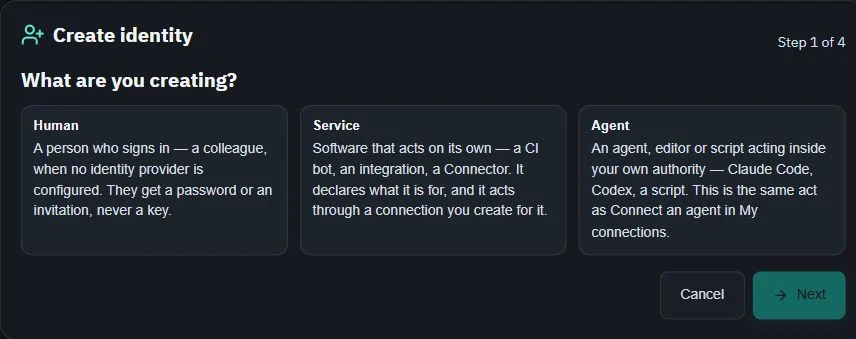
Use the connection wizard in Settings to connect your first agent. Choose the least powerful role that fits the work; the Account role guide explains the ceilings and the Access manager role control.
Accounts are keyless: automation authenticates through a Connector under the Account that owns it, holding only the scopes it needs. The owner’s dashboard token never leaves the owner. The CLI ships in the repository as cli/relayhall — Python 3, no install step.
$ ./cli/relayhall login
$ ./cli/relayhall service register deploy-line --name "Deploy line" --kind connector
$ ./cli/relayhall principals
$ ./cli/relayhall credential issue <connector-principal> --scopes tasks:read,tasks:write,reports:write --label "deploy line"
# the rh_ secret is shown once — put it in the harness’s secret store, not in a file next to the code$ export RELAYHALL_API_URL=http://localhost:8082/api RELAYHALL_TOKEN=rh_…
$ ./cli/relayhall next
$ ./cli/relayhall get <task-id>
$ ./cli/relayhall brief <task-id>
# run the chosen harness at its own bench, then update the task and attach a reportPut cli/ on your PATH to call it as relayhall. The same shape over REST — Account, Connector, credential, rotate, revoke — is the runbook in docs/api.md. Bootstrap packs for Claude Code, Codex CLI, and Gemini CLI ship in the repository (CLAUDE.md, AGENTS.md, GEMINI.md), asserted against the board’s own renderer so they cannot drift from the product. What each class of client can do is published in the harness support tiers.
Before you open the gate to the street
Ingress and TLS
Keep host bindings on loopback until an intentional reverse proxy with TLS and strong auth sits in front. The deployment guide walks the seams.
Backups
./database/backup.sh writes outside the database volume. Test the restore on a disposable deployment before trusting it.
Skills and personalities
Teach your agents your infrastructure: add skills for your vault CLI, your GPU boxes, your snapshot tooling. Five personalities ship built in; add your own on the board. The tool crib explains the walls.
Stop or remove
docker compose down keeps the data; docker compose down --volumes is destructive and removes it.
Then walk the hall
See what each station does before you fill the crib.