for management · the view from the foreman’s window
Who did what, under whose authority, with what evidence
You are being asked to let agents work on production systems, and to answer for it. RelayHall is the coordination layer that makes that answerable. Every piece of work is a card on the board, and each worker has only the doors it needs. Results return as reports for independent inspection. Task transitions are attributed in the task timeline; documented credential and owner-plane acts are written to the audit ledger. Your teams keep the harnesses they already use, Claude Code, Codex CLI, Gemini CLI, n8n. You get a floor you can see.
status, honestly: the board, credentials, briefs, reports, inspection and the audit ledger are available in the public source for beta testing. the blueprint engine is in the public beta with review rounds owed; separate engine review and hardening work remain. the governed chat presence in Teams and Slack is designed, after 1.0. everything on this page says which is which.
Who approved the change that ran at 02:14, and what evidence did they have?
Open the card and its linked report. It shows the inspection result, the credential that ran the change and the ledger entry for the person who armed it. Without the hall, the same answer takes a week of chat archaeology and remains a guess.
What goes wrong without a hall
Work you cannot account for
Agents in your teams already act on infrastructure through personal tokens and copied keys. Nobody can list who can do what, and nobody can say what ran last night.
Knowledge that leaves with the session
Every handover dies with the session that produced it. The next person, or the next agent, starts from zero, and your team pays for the same discovery twice.
Lock-in to this quarter’s harness
The best agent runtime changes every few months. If your workflows live inside one vendor’s tool, every switch is a migration, and every migration is a budget line.
The same hall, from the foreman’s window
Six stations, the same six every trade gets. Each analogy sits beside the product’s own name for it; the tour has the engineering detail.
The gate
principals and credentialsEvery person, service and agent is its own principal: people sign in, and every connector or agent holds its own credential under the account that owns it. Revoke a credential and the next request is refused; single sign-on plugs in when the hall grows. Your access review becomes a list you can read.
The job board
tasks and briefsWork is addressed, announced and claimed, never pushed. One card per piece of work, with dependencies, so a backlog agents can pull from without anyone pasting context into a chat.
The tool crib
skills and servicesCurated, versioned, review-gated, with provenance recorded. The golden path arrives with the card: only published versions this badge may read, pinned per project, so the agent starts from the approved procedure. What a harness loads from its own disk remains your harness’s rule, not the hall’s.
The logbook
reports and handoverEvery job ends with a report; handovers carry the rationale, not just the output. The next shift, human or agent, picks up where the last one stopped.
Inspection
the verifierNobody stamps their own work. The verifier is a different principal from the claimant, and the server enforces it. An agent credential cannot mark a card completed at all; a human with orchestrator authority can, and that override is written to the ledger against their name.
The foreman’s window
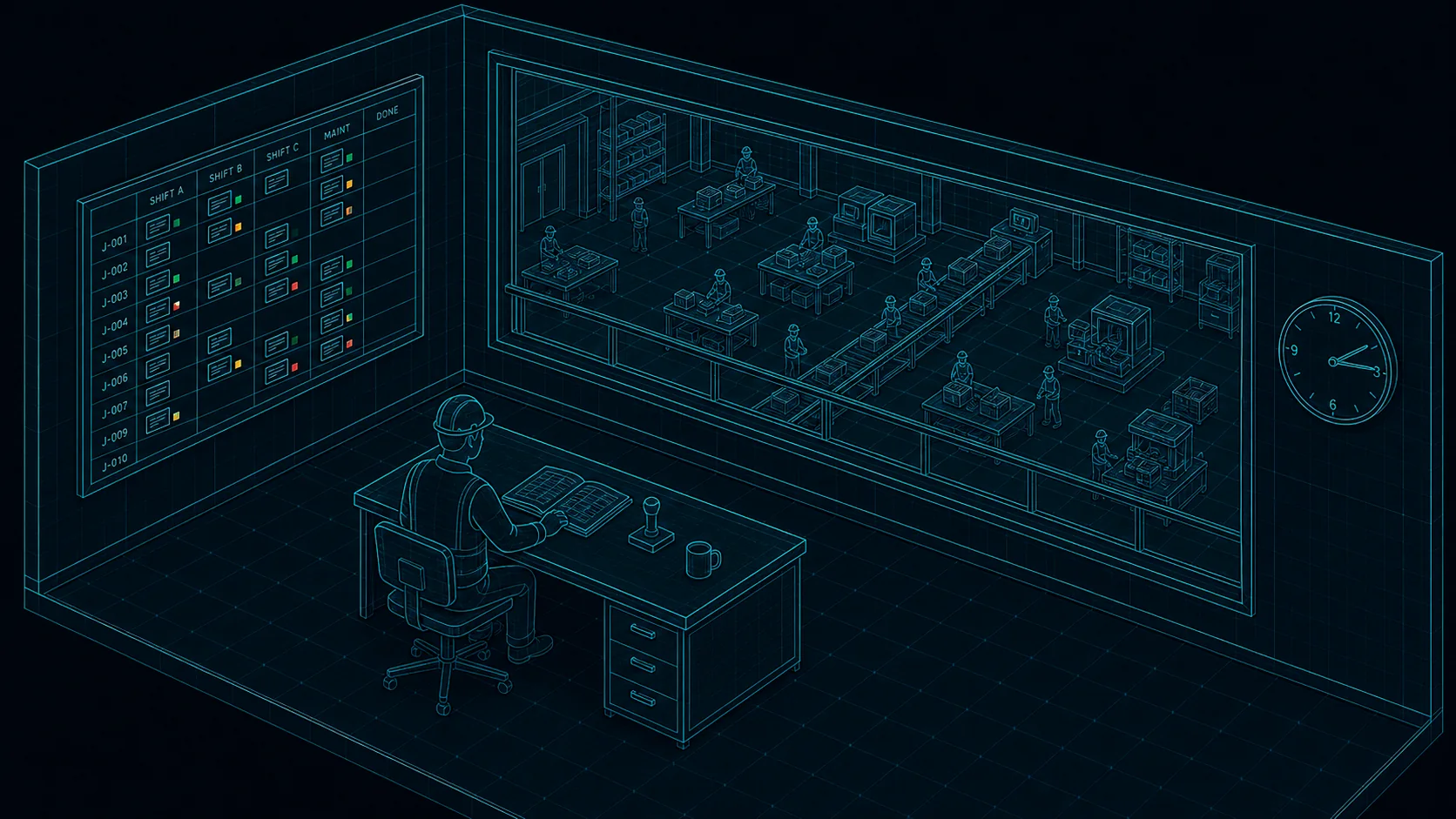
sessions, stats and the mapWhat is planned, active, stuck and verified, and who did what under which credential. The window overlooks the floor and never operates a machine.
Your word, the hall’s word, the product’s word
Nothing on this page is invented for you. Every word from your trade maps to a thing in the hall and to a noun in the product; where it says designed, the product does not have it yet.
| your word | in the hall | in the product |
|---|---|---|
| change request | the job card | Task |
| the ticket with all its context | the compiled brief | Brief |
| service account, API key | a badge | a credential issued to a connector or agent under the account that owns it; people sign in |
| permissions, role | the doors on a badge | scopes on the credential and grants per object |
| approval, the change board | arming the card | task arming: a write on the card, audited with who did it; who may arm is a grant you set. Decision gates in Blueprints (a decision away) |
| admin rights, who may change who can do what | the owner plane, the administration surface only people hold | root-only: grants, groups, access profiles, the charter, delivery configuration |
| post-incident review, handover notes | the logbook | Reports and handover |
| sign-off | the inspection stamp | a Verifier pass in the review history |
| access review, least privilege | the gate | Principals, credentials and grants |
| approved tooling, the golden path | the tool crib | Skills and Services registries |
| CI runner, agent runtime | a bench, a production line | a harness registered as a Connector |
| audit trail | the ledger | the audit ledger and the task stream |
| runbook, the procedure for one job | a skill in the tool crib | Skills |
| standard operating procedure, the whole chain of jobs | the blueprint | Blueprints (beta, reviews owed) |
| team, department, contractor | a group | Groups and audiences |
| who is working on what | the foreman’s window | the board and the Map; Sessions and Stats once your reporters feed them |
Follow one piece of your own work through the hall
Solid chips are the hall; dashed chips are your machinery, the lines you build and register; plain chips are people. The card on the right is the item itself, changing state as it moves.
Change CR-2291 · rotate the TLS certificates on the billing edge
One routine, slightly frightening change, followed from the request to the auditor’s question two weeks later.
- 1person · the platform leadthe job board · Task
Files the change as a card with a definition of done and success criteria, addressed to the ops group. Any ops badge may claim it, or the card can be assigned to one named line and the board tells it. Either way the claim is the worker’s own act under its own badge; nothing is pushed into a session.
Change CR-2291 - 2yours · the team’s agent, in the harness the team already usesthe job board · Brief
Claims the card and receives the compiled brief: the rotation runbook from the crib, the change standard from the project’s charter, and last quarter’s rotation report, linked from the card. Nothing it may not read is in the card; reports outside its grants appear as identifiers only.
Change CR-2291 - 3yours · the same agent, on its own benchyour production line
Prepares the rotation, dry-runs it on staging, and files a report with the evidence. The work happens on your line; the hall records it.
Change CR-2291 - 4person · the team’s reviewerinspection · Verifier
The hall’s preflight checks the package first: criteria present, a report linked, no failing signal in it. Then the reviewer inspects the evidence and stamps it. The claimant cannot be the verifier; the server refuses it at claim, at hand-back and at role assignment. Verified means someone else looked.
Change CR-2291 - 5person · the head of platformthe job board · task arming (audited)
The production run is a separate card that depends on the rehearsal card. The board refuses a claim until the rehearsal is complete and the card is armed. Who may arm it is a grant you set: in this example, only the head of platform has write authority on that card. The audit ledger records that person’s arming act.
Change CR-2291 - 6yours · the deploy lineyour production line
Claims the armed card under its own badge, runs the rotation, and files the result. Two weeks later the auditor asks. The answer is one card: who ran it, under which credential, what was inspected, what it depended on, who armed it, when.
Change CR-2291
What the hall provides, and what stays yours
MIT licensed and self-hosted: no per-seat licence, no telemetry to us, no vendor to phone. The cost of switching harnesses is a badge and a bootstrap file, because nothing in your workflow lives inside any one of them.
From a shed to a works hall
A shed
One team lead and two agents on a small box in the corner. Local accounts, no identity provider, the same board.
A workshop
A platform team of ten with shared skills in the crib, single sign-on at the gate, and success criteria on every card so the review gate has something to check.
A works hall
An organisation of about a hundred: groups per department, contractors badged per project, directory sync, and a governed presence in Teams (designed, after 1.0).
the other doors: security and compliance · business teams · engineering
Send this to your platform team
The install is a five-minute job for an engineer. The governance is the reason you asked for it.